Cultural Appropriation in Fashion

“Fashion demands innovation” and one of the easiest ways of accessing this is by looking into “other cultures for the novel and exotic” (Ann Marie Leshkowich, “What Happens When Asian Chic Becomes Chic in Asia?” 2003, page 282). It emphasizes the difference or “otherness” between Eastern and Western cultures. Therefore, the “Asian style” becomes something desirable to the North American and European eye because of its exoticism.

“Capital is universal, it does no discriminate, the world is its oyster, it will incorporate any local taste and offer it to the world through the frame of late capitalist globalized market economy, so long as it sells” (Leshkowich, 14). In summary, this means that designers and consumers play a big part in the continuation of these practices. While these practices have potential to harm certain ethnic and cultural groups they can also bring about the importance of multiculturalism.

The practice of “Asian Chic”can have negative consequences on the meaning of the traditional clothing. For instance, it may devalue the significance of the garment, lead to an erasure of a culture’s traditions by making it a common form of dress, or promote Orientalism, fetishization and dehumanization of a group of people. At the same time, if done right, it could form bridges between cultures and encourage multiculturalism. If the latter were to happen, there would need to be some inclusion of people from that cultural group being represented in order to maintain authenticity.

On June 24, 2015 the Museum of Fine Arts (MFA) was involved in a controversy regarding Claude Monet’s 1876 La Japonaise painting. The nineteenth-century portrait portrays an image of Claude Monet’s wife, Camille, in a red Japanese kimono with a red, white and blue fan and wearing a blonde wig to “emphasize her Western identity” (Michelle Liu Carriger “No ‘Thing to Wear’: A Brief History of Kimono and Inappropriation from Japonisme to Kimono Protests” 2015, page 165). There was also a replica of the kimono from the painting that visitors could try on. As a result, protesters claimed this was cultural appropriation, “orientalism, exotification and racism” (166). Counter protesters argued that this was a form of cultural appropriation because it introduced Japanese culture to non-Japanese people through a playful and interactive way.

When non-Asian artists and designers profit off of culturally Asian objects, it can lead to serious consequences and mixed responses. For instance, it could lead to an erasure of cultures and the significance and history of traditional items. It also can also potentially present those cultural groups as exotic and inferior. At the same time it can encourage the beauty of diversity and multiculturalism. All in all, the divide between cultural appropriation and appreciation is quite difficult to distinguish. However, there is one way to differentiate the two: who is benefiting from the exposure and who’s being exploited? The one profiting from the exposure but doesn’t belong to the specific cultural group while those in the cultural group are suffering would be participating in cultural appropriation.

Does Cultural Appropriation have a Double Standard?

Is it possible for there to be a double standard when it comes to cultural appropriation? Can Asians from different cultures be accused of cultural appropriation of another Asian culture or do they get a “pass?” What happens if a non-Chinese, Asian person decides to wear a sexualized Chinese dress?

To begin, let’s briefly discuss the backgrounds of the people who will be analyzed in this post: Yumi King, Orange Caramel, and KatieAegi. Yumi King is a Chinese Youtuber who does DIY fashion and beauty videos with heavily influenced Chinese looks. Orange Caramel is a popular K-pop girls group. KatieAegi is a controversial Instagram content creator who has shown intense interests in Asian culture. .


The first connection in the controversy is between KatieAegi and Orange Caramel. KatieAegi did a dance cover of Orange Caramel’s song titled, “Shanghai Romance” that she deleted shortly after it was posted. In the video, she was wearing a shorter version of a cheongsam (traditional Chinese dress). She was met with a lot of negative responses, in which, many claimed she was culturally appropriating and fetishizing Asian culture. On the other hand, in one of Orange Caramel’s live performances of Shanghai Romance they also chose to wear short cheongsam dresses. In their case, they were met with compliments about the music and how pretty they looked. Both the members from Orange Caramel and KatieAegi aren’t Chinese yet KatieAegi received more hate for wearing a Cheongsam than the K-pop group.

The reason why Orange Caramel and KatieAegi’s outfits all elicited different responses is unclear. One possible reason why KatieAegi faced backlash is because of the dangers of exoticism and orientalist ideas that emphasize the “otherness” element of Asians. People may assume that because she’s not Asian, she’s using the Cheongsam to continue the practice of Asian culture as a style “symbolically domesticated, simply a trend to be consumed” (Ann Marie Leshkowich, “What Happens When Asian Chic Becomes Chic in Asia?” 2003). In other words, using Asian culture as a fashion accessory and object rather than understanding it’s deep-rich history and significance.

Yumi’s Style – Fashion, Beauty. YouTube, YouTube, 25 Oct. 2016, http://www.youtube.com/watch?v=l-RotAWLpqk.

Yumi King created a video titled “DIY Qi Pao/Cheongsam + Pattern Making | DIY Traditional Chinese New Year Dress.” Once again, like Orange Caramel and KatieAegi’s outfits, Yumi King’s cheongsam is short and sits above the tops of her knees. When it comes to King’s case, she also received positive feedback from viewers, expressing how much they love her outfit. There were also many comments worrying about appearing racist if they wore the dress. One comment said, “I hope Chinese [people] will not be offended by people wearing clothes of their culture” (Yuhei, 2019). This presents the question of who has the right to wear traditional clothing and is it racist if you wear traditional clothing outside of your race?

In short, those belonging to the specific cultural group being discussed have the right to wear their traditional clothes. When it comes to those not belonging to the specific cultural group, it can be quite difficult to determine whether it’s cultural appropriation, appreciation, or exchange. It all comes down to validation, authenticity, and respect. As long as you’re respectful and understand the significance of the cultural clothing, it would be considered cultural appreciation. Unfortunately, when it comes to being “respectful,” it’s completely arbitrary. Sometimes authenticity can be objective depending on the situation.

This can be seen in Orange Caramel’s circumstance. They might’ve been able to get away with the inclusion of an altered version of the cheongsam despite not being Chinese because they’re Asian; therefore, they somehow are validated to wear this article of clothing without backlash. On the other hand, because of continuous representations of using Asian clothing as a fashion statement in the Western world, KatieAegi is seen as appropriating the culture. This is what makes cultural appropriation such a difficult concept to understand because it’s all dependent on the cultural meanings and practices to determine whether or not something is deemed as appropriation.

The Desire of “Western Features”

Could East Asians also be participating in cultural appropriation practices when it comes to their popular cosmetic surgeries? Is this a form of cultural appropriation or an inevitable practice because of heavy contact with Western countries?

The top image shows the more common “monolid” eye type that most Asians have. The image on the bottom shows the “double eyelid.”

The image shown above is a popular cosmetic surgery feature desired in many Asian countries. This is popularly known as Blepharoplasty or “the double eyelid” and is supposed to resemble the most common physical trait found in non-Asian or “Western” people. Essentially, the double eyelid is a folding of skin that is uncommon to the more prominent “monolid” seen on Asian people.

In addition to this, there has also been a surge in at home, non-surgical methods to help people achieve these features. For instance, Daiso sells a product in their stores that allows people to give themselves a double eyelid with ease. It’s an adhesive based piece of fabric that people place on their eyelids. By placing the adhesive bandage onto their eyelid, it pulls the skin back to recreate similar folds to a double eyelid. An image of this product is shown below.

Double eyelids are viewed as beautiful in many Asian countries because of the deep-rooted desire to look more “Western.” In other words, this is a prime example for how Westernization has impacted beauty standards in other countries.

The desire to achieve idealized Western features probably stems from other practices performed in Asian countries in the past. For instance, fair skin was significant because it could determine social status. Those with lighter skin tones were considered wealthy because they didn’t have to do intensive outdoor labor. Similarly, those with dark complexions were instantly recognized as poor because their skin tones suggested they were working outside. All in all, this and many other examples present how current beauty standards may be an extension of previous standards.

It could be argued that this form of surgery presents a double standard to the concept of cultural appropriation. Why is it okay for Asians to alter their facial features to adopt a common facial feature of another race? The reason is due to biopower and hegemony. Biopower is “the management of institutions that classify and organize humans (and other natural life) for social control” and is a theory presented by French philosopher Michael Focault. Whereas hegemony refers to a dominating group who helps define social hierarchy and cultural meanings. These practices work together to create the foundations and guidelines of a society.

The “double eyelid” surgery was popularized by American doctor, David Ralph Millard around the early to mid-1950’s in South Korea. He was originally a military doctor who worked shortly after the Korean war and focused on reconstructive surgery. He believed he could help build a bridge between Americans and Asians through this medical procedure. Prior to his first Blepharoplasty surgery, he claims that because of Asians “squint” and slanted eyes, they were seen as untrustworthy and hard to read. He believed that by performing this surgery, he was helping Asians seem more likable. Unfortunately, it only hinders Asians because it presents them as abnormal.

Take for instance, Julie Chen from the popular show “The Talk.” When she asked for advice to help advance her career in television, she was encouraged to undergo double eyelid surgery because her monolid eyes made her appear uninterested and hard to read. (Vivian Le, “Double Standards” 2018). When she revealed this to her audience in 2013, she was met with positive reactions as crew members said she looked “fabulous” and “expressive.” At the same time, there were people that believed she was a sell out and was ashamed of her Asian heritage.

Nowadays, Koreans no longer undergo this surgery solely based on the origins but based on their own cultural standards of beauty. They’ve taken their power back by undergoing the surgery because they want to and not because Westerners are telling them it’ll make them appear interesting. This demonstrates how meanings and beauty standards within a culture can change overtime, in which, can lead to positive change.

In the end, this medical procedure is most likely not a form of cultural appropriation. Instead, it represents how specific marginalized groups (Asians and Asian Americans) have been scrutinized because of their natural features. It’s due to their natural features that hegemonic powers (Westerners) have attempted to find solutions such as Blepharoplasty to fix their “flaws” and make Asians appeal more to Western ideals. And as time passes, these marginalized groups can repossess find a way to regain their power by changing the meaning and reasons behind their actions.

Social Media’s Reactions to “Cultural Appropriation”

We have a responsibility to listen to people of marginalized cultures, understand as much as possible the blatant and subtle ways in which their cultures have been appropriated and exploited, and educate ourselves enough to make informed choices when it comes to engaging with people of other cultures.

Jarune Uwujaren

Twitter is a popular online platform that allows users to share information from a range of topics. People can post images, short statements, and news. Through the use of “hashtags,” users can categorize and find posts related to a specific subject quickly. This especially becomes useful when people want to find more information about a topic that interests them. Afterwards, they can choose to discuss with others on the site.

The purpose of bringing up social media is to describe how it brings about discourse, awareness, and creates meaning. The use of “hashtags” is one method of bringing about awareness as it allows users to create their own terms that can be understood by a group of people. “hashtags” also create meaning and discourse as can be seen in the #MeToo” movement. This was a movement where women and supporters banded together on different social media platforms to raise awareness about sexual violence. As more people kept tagging this term, it grew in popularity. As a result, it lead to discussions about sexual violence, specific stories, and the controversies behind the issue; therefore, presenting how powerful social media is.

While these platforms can bring about positive change through discussion and exchanging of information, it can also make understanding more difficult. One example occurred with the user “@daumkeziah.” Back in April 2018, Keziah Daum was accused of “#culturalappropriation” and ignorance when she chose to wear a traditional Chinese dress to her senior prom. Asians and non-Asians commented their opinions on the situation and the reactions were mixed.

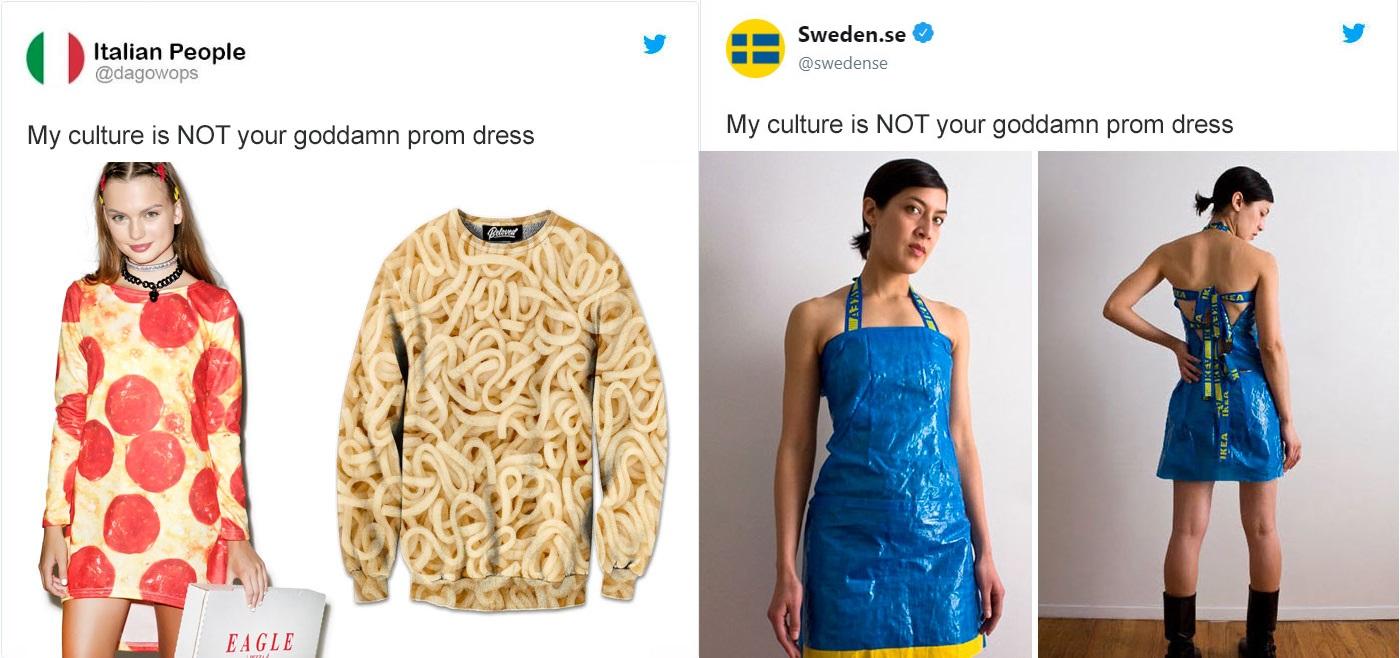
There were comments from angry users stating that because she doesn’t know the history or cultural significance of the dress, it’s disrespectful to Chinese people. Katana, also known as “@bunchukuu” responded with “Our traditional dress isn’t meant to make you appear more ‘exotic.'” In addition to this, Jeremy Lam, also known as “@jere_bare” reacts with “My culture is NOT your goddamn prom dress.” There were also comments arguing this is a good thing because it embraces diversity. Another Twitter user replied with “I’m eating tamales with chopsticks. This is why America was founded.” In other words, they’re implying that America is built on multiculturalism and by forbidding someone from wearing a traditional dress separate from their own is unnecessary. By embracing the “otherness” aspect that comes with experiencing different cultures helps build a bridge of multiculturalism. By discouraging this, it could potentially create a bigger divide between Asian and non-Asian communities.

Another reason many people were offended by Keziah’s photos was because of a pose her and her friends did. Many believed that the combination of the dress and the hand gestures were used as a way to mock stereotypical Asian representations and poses. It was later found to be untrue and that this pose was based off a popular meme at the time called “#papabless” created by Ethan Klein (USA Today). This proves that meanings differ depending on one’s personal knowledge and culture. Some saw it as a way to mock Asians while others understood it from its meme roots.

As a result, this controversy lead to a creation of related memes based on Jeremy Lan’s “my culture is NOT your goddamn prom dress.”

Controversial discussions need to be talked about otherwise, there will be no change in our society. Without understanding the different topics presented through platforms like Twitter, people wouldn’t understand concepts of diversity and cultural appropriation. In Keziah’s case, Twitter works as a way to bring up discussion about cultural appropriation versus cultural appreciation. While there are mixed opinions Twitter is beneficial because it shows different cultures and his is the importance of social media outlets like Twitter because they encourage discussions and people to post and inform others about content within our society.

Why Cultural Appropriation is Confusing

Cultural appropriation is viewed as a practice that encourages ignorance and racism and tends to evoke a negative emotion from minority groups. One example of such practices can be seen in the ways costume companies present their “ethnicity-themed” outfits. In which, companies will base costumes on what they believe traditional Asian clothing looks like. As a result, this form of visual culture tends to offend and misrepresent a group of people because of its inaccuracy. It does this by generalizing Asian countries into a common narrative while disregarding their drastic cultural differences.

Educational institutions such as Princeton University believe it’s important to engage “in a dialogue about the impact of cultural appropriation, Halloween, and why culture is not a costume” (Avery Matera, “Cultural Appropriation on Halloween: How Colleges Are Responding Teen Vogue” 2017). By engaging in discussion about these practices, it raises awareness about the issue of misrepresentation and inauthenticity of culture groups. As a result, mutual respect of otherness is built and people can learn how to appreciate each other’s heritage. Overall, it’s important to present authentic representations for groups because, “inaccuracies become ingrained in our society and have real consequences for those that are inaccurately represented” (Antwaun Sargent, “With Joyful Photos, a 19-Year-Old Artist Confronts Media Bias Against Black Male Teens” 2017).

The line between cultural appropriation and cultural appreciation is very thin. While some believe cultural appropriation should be stopped others believe it’s a positive and inevitable thing. For instance, in Jenni Avins “The Dos and Don’ts of Cultural Appropriation” the author explains how modern culture would cease to exist if appropriation didn’t exist. Modern culture meaning the mixing of various cultures that are presented in popular visual culture and understanding. One example being “fusion cuisine.” This is where two or more cultures combine the most common flavors found in their foods and combine those flavors to create a “fusion.”

While cultural appropriation has a bad reputation for disrespecting cultures, it’s been practiced throughout history. For instance, what’s currently known as the traditional Chinese clothing “qipao” or “cheongsam” isn’t Chinese but Manchurian. While nationally, Manchurian and Chinese are the same, they’re ethnically different. Originally the Chinese wore a different traditional attire (hanfu) but once the Qing dynasty was in power, everything changed. The Chinese were forced into wearing Manchurian clothing or refuse and be punished by death. (Sin Chen Yeong, “Do You Know That Cheongsam is Not Chinese Traditional Clothing?” 2010) While this could be argued not cultural appropriation because it was an enforced law, it does present a case where cultural appropriation and adoption was acceptable and considered necessary. This also demonstrates how cultural appropriation shapes current understandings of cultures as they adopt from other cultures to create their own.

This doesn’t justify forms of negative cultural appropriation which work to misinform others about different cultures. This is just to state how cultural appropriation has been practiced throughout history and the positive aspects of cultural appropriation that could also be characterized as cultural appreciation or exchange. This also presents how our current understanding of well-known cultures such as the Chinese have contributed to cultural appropriation practices.

Image result for japanese wedding tradition folding 1000 origami cranes

An example of positive cultural exchange that was done out of free will is my Aunt and Uncle’s wedding. My Aunt is Chinese while my Uncle is Japanese; they wanted to incorporate both aspects of their culture into their wedding. My Aunt incorporated Chinese culture through the reception when she decided to wear a red traditional cheongsam dress. On the other hand, my Uncle incorporated Japanese culture by having the bridesmaids and groomsmen fold 1000 golden paper cranes. After these cranes were folded, they were assembled together to create a crane picture also known as “tsuru.” While I don’t have access to their specific design, I’ve included an image of a similar one.

Overall, cultural appropriation has both negative and positive connotations. While cultural appropriation can create misinformation about a group of people through inaccurate representations, cultural exchange and appreciation presents the beauty of multiculturalism.